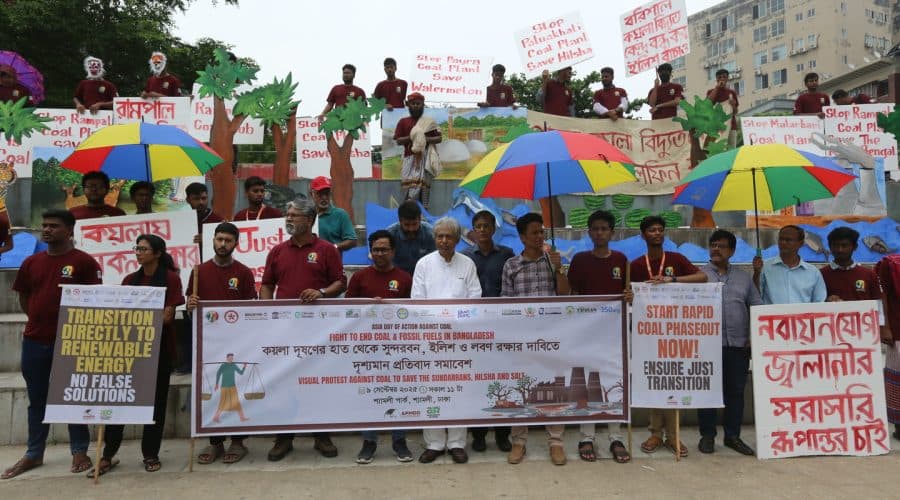
"On 9 September 2025, a prominent and symbolic protest gathering was held to protect the Sundarbans, Hilsa fish, and salt production from the harmful impacts of coal-based power generation. The event was organized as part of a global campaign initiated by the Asian Energy Network and the Asian Peoples’ Movement on Debt and Development ahead of the United Nations General Assembly, calling on world leaders to accelerate the transition away from coal and adopt renewable energy solutions.
The gathering highlighted growing concerns over environmental degradation, public health risks, and livelihood losses associated with coal-fired power plants operating in ecologically sensitive regions of Bangladesh.
The protest gathering was jointly organized by Dhoritri Rokkhay Amra (DHORA), Bangladesh Krishak Federation, Brighters, Centre for Atmospheric Pollution Studies (CAPS), Climate Frontier, Centre for Participatory Research and Development (CPRD), Environmental Research and Development Alternatives (ERDA), EquityBD, Global Law Thinkers Society (GLTS), Khasia Students Union, Mission Green Bangladesh, OAB Foundation, River Bangla, Riverine People, Shocheton Foundation, Sundarban O Upakul Surakkha Andolon, Waterkeepers Bangladesh, Youth and Environment Development Organization, Young Climate Action Network, and 350.org.
"
The event was chaired by M. S. Siddiqui, Co-convenor of Dhoritri Rokkhay Amra (DHORA), and moderated by Foysal Ahmed, Editor of River Bangla. Sharif Jamil served as the keynote speaker, alongside representatives from environmental organizations, academic institutions, and farmers’ associations.
Speakers emphasized that coal remains one of the leading contributors to climate change, environmental pollution, and public health crises worldwide. They called for an immediate roadmap to transition from coal-based power generation to renewable and sustainable energy sources.
Special attention was given to the environmental impacts of the Rampal, Payra, and Matarbari power hubs. According to speakers, pollution from these coal-fired power plants threatens some of Bangladesh’s most valuable natural resources, including the Sundarbans, Hilsa fisheries, agricultural production, and coastal salt industries.
The discussion highlighted concerns that industrial activities associated with coal power projects have negatively affected biodiversity, fisheries, agriculture, food security, and the livelihoods of thousands of coastal communities. Participants urged policymakers to prioritize environmental protection, renewable energy investment, and climate-resilient development strategies.
Key Messages
Coal-fired power plants are contributing significantly to climate change and environmental degradation.
The Sundarbans, Hilsa fisheries, and coastal salt production require urgent protection from industrial pollution.
Bangladesh should accelerate its transition from fossil fuels to renewable energy.
Environmental justice and community rights must be prioritized in national energy planning.
Youth and civil society have a critical role in advocating for sustainable development and climate action.
Objectives
Raise public awareness about the environmental and social impacts of coal-based power generation.
Advocate for renewable energy alternatives and a just energy transition.
Protect ecologically sensitive regions and natural resources.
Strengthen collaboration among environmental organizations and citizen groups.
Encourage policymakers to adopt sustainable and climate-friendly energy policies.
Outcomes
Increased public awareness regarding coal pollution and climate risks.
Stronger advocacy for renewable energy and environmental protection.
Enhanced collaboration among environmental, youth, and community organizations.
Greater visibility of issues affecting the Sundarbans, fisheries, agriculture, and coastal livelihoods.
Renewed calls for a national roadmap toward sustainable energy development.